
Autonomous Response Platform

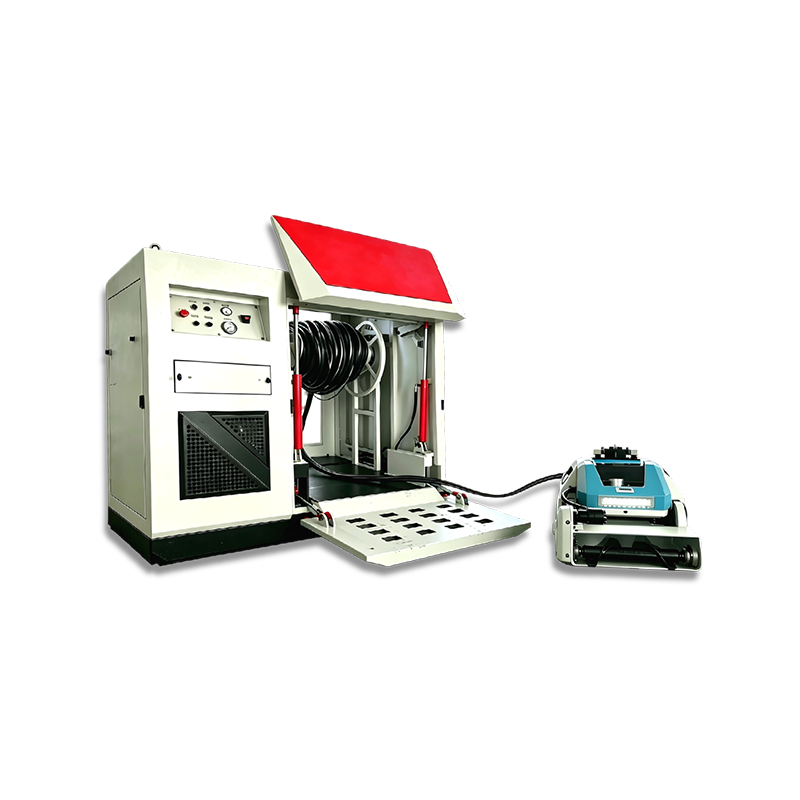
Autonomous Flood Water Removal Robot

Self-navigating dewatering system for unattended flood response, continuous sump management, and automated water level control in critical infrastructure

Autonomous Navigation Mode
380 m³/h Discharge Rate
72 h Unattended Runtime
4G / LoRa Remote Telemetry
Autonomous Navigation System

The robot employs a sensor fusion navigation stack combining LiDAR, ultrasonic ranging, and inertial measurement to map and traverse flooded environments without operator input. A pre-loaded site map enables the unit to plan optimal routes between water accumulation zones and discharge points. Obstacle detection operates at 20 Hz, allowing the robot to avoid submerged debris, structural columns, and uneven terrain. When the primary route is obstructed, the navigation engine recalculates a viable path within 1.5 seconds. The system supports both fully autonomous mode and supervised remote operation, with seamless handover between the two.

LiDAR 360° IMU 9-axis Path replan < 1.5 s
Water Level Sensing and Adaptive Pump Control

The unit integrates a dual-redundant water level sensing array comprising ultrasonic sensors and pressure transducers. The system continuously monitors water depth with 5 mm resolution and automatically activates the pump when depth exceeds a configurable threshold. Pump speed modulates in response to inflow rate, maintaining optimal discharge efficiency while preventing dry-run conditions. When water level drops below the minimum operating depth, the pump enters standby mode and the robot relocates to the next accumulation zone. All threshold parameters are configurable through the remote dashboard.

5 mm resolution Auto start/stop Dry-run protection
Extended Unattended Operation

The power system combines a 48V lithium iron phosphate battery pack with an onboard diesel generator for continuous operation. In battery-only mode, the unit operates for 8 hours. With the generator engaged, runtime extends to 72 hours without refueling. The robot automatically returns to its docking station when battery state of charge falls below 20 percent, recharges, and resumes its patrol cycle. Fuel consumption is monitored in real time, and low-fuel alerts are transmitted via the telemetry link 30 minutes before depletion. The system is configured for deployment durations typical of multi-day flood events.

48V LiFePO4 72 h generator Auto-docking
Remote Telemetry and Fleet Integration

The robot transmits operational data through dual-channel communication: 4G LTE for high-bandwidth video and telemetry, with automatic fallback to LoRaWAN for extended range in areas with poor cellular coverage. The cloud dashboard provides live position tracking, water level history, pump performance curves, and battery state of charge. Fleet management capabilities support simultaneous monitoring of up to 24 units across multiple sites. Integration with SCADA and municipal emergency management platforms is available through RESTful API and MQTT protocols.

4G + LoRa fallback Fleet up to 24 units REST / MQTT
Technical Parameters Engineering Data Sheet
Navigation sensors 360° LiDAR, 6x ultrasonic, 9-axis IMU
Water level sensing Ultrasonic + pressure transducer, 5 mm resolution
Discharge capacity 380 m³/h at 14 m head
Maximum solid passage 50 mm
Battery capacity 48V 200Ah LiFePO4
Generator output 12 kW diesel, 40 L tank
Communication 4G LTE, LoRaWAN fallback, Wi-Fi configuration
Chassis protection IP67
Operating temperature -10°C to 50°C
Curb weight 340 kg
Target Deployment Environments
Underground Parking Facilities Continuous water removal during storm events without operator presence
Subway and Rail Tunnel Sumps Automated pump management in inaccessible drainage chambers
Industrial Plant Drainage Pits Round-the-clock water level control in process areas
Municipal Flood Control Zones Pre-positioned units activated by rainfall forecast triggers
Construction Dewatering Operations Unattended sump management across large excavation sites
Wastewater Treatment Facilities Emergency overflow prevention in critical process basins
Procurement and Integration Notes
System configuration Autonomous robot unit, docking station, 20 m discharge hose, cloud dashboard access, installation and commissioning service
Site survey requirement Pre-deployment site mapping and threshold configuration conducted by technical team, typically 1-2 days per site
Integration interfaces RESTful API, MQTT broker, Modbus TCP for SCADA connectivity; webhook support for alert forwarding
Operator training 1-day dashboard and fleet management training; autonomous mode requires no continuous operator presence
Service and support 24-month warranty; remote diagnostics included; preventive maintenance visits every 6 months
Regulatory compliance CE, UKCA, FCC, and RoHS certified; telemetry modules compliant with regional radio regulations
Technical Clarifications

The navigation stack processes LiDAR and ultrasonic data at 20 Hz, detecting obstacles within a 5-meter radius. Upon detection, the robot decelerates and attempts to navigate around the obstruction. If no viable path exists within 1.5 seconds, the robot halts, transmits an alert to the remote dashboard, and awaits operator instruction. The operator may then manually guide the robot past the obstacle or dispatch personnel to clear it.

In the event of communication loss, the robot continues operating in autonomous mode using its onboard navigation and control systems. All operational data are logged locally. Upon restoration of the communication link, the robot synchronizes logged data with the cloud dashboard. If communication is lost for more than 24 hours, the robot completes its current cycle and enters a safe standby state until reconnection.

Site mapping is performed by our technical team during the pre-deployment survey using a portable LiDAR scanner. The resulting point cloud is processed into a navigable 2D occupancy grid with elevation data. This map is loaded onto the robot and serves as the reference for path planning. For sites with dynamic layouts, the map can be updated remotely through the dashboard using new survey data.

LiDAR and ultrasonic sensor windows should be cleaned weekly or after each flood event. The navigation map should be reviewed and updated quarterly for sites with changing layouts. Battery capacity should be tested semi-annually. The docking station contacts should be inspected monthly for corrosion. Generator maintenance follows standard diesel engine service intervals.

Yes. Up to 6 units can operate simultaneously on a single site with coordinated task allocation. The fleet management system assigns water accumulation zones to individual robots based on proximity, battery state, and pump capacity. Collision avoidance is maintained through inter-robot communication and shared map updates. Larger deployments can be managed across multiple sites through the central dashboard.

Est. 2014 high-end hydraulic
Wuhu Qisheng
Intelligent Equipment

Professional China designer & custom manufacturer, suppliers of Autonomous Flood Water Removal Robot for emergency, rescue, agricultural water conservancy, and environmental protection.

Deeply engaged

We keep up with industry trends and empower efficient operations with professional strength.

Senior R&D engineers Technical pain point solutions Efficient production system Rapid market response
200+
projects delivered
98%
on‑time delivery
emergency rescue environmental agricultural water
Engineering excellence

Deeply engaged in the hydraulic equipment industry, we keep up with trends and empower efficient operations with professional strength. Our core competitiveness lies in strong technological and production capabilities.

We have a team of senior R&D engineers with rich practical experience. Accurately grasping technical pain points and demand directions, we provide solid support for product innovation.

Our engineers work closely with clients to translate operational challenges into precise technical specifications, ensuring every solution is fit for purpose.

Production & agility

Equipped with an efficient production system, we realize seamless connection between R&D and production, quickly respond to market changes, meet diverse customer needs, and ensure delivery efficiency and product stability.

Rapid prototyping & testing
Flexible manufacturing capacity
Just-in-time inventory management
End-to-end quality control
Lean production workflows
Automated assembly lines
24/7technical support
100+custom solutions
48hrapid response
99%quality pass rate
Product portfolio

Our products cover multiple categories including hydraulic power stations, slurry pumps, integrated and portable water pump equipment, and hydraulic breakers — for drainage, dredging, forest fire fighting, cutting, drilling, and sand suction.

With comprehensive functions, our products can be widely used in various scenarios such as drainage, dredging, forest fire fighting, cutting, drilling, and sand suction, adapting to the actual operation needs of core fields such as emergency rescue and environmental construction.

Non‑electric drive

Safe operation in hazardous environments, high lift, strong wear resistance, easy mobility — hardcore equipment under complex working conditions.

Customized R&D

Full‑process tailored solutions to solve your personalized operation problems. We design exclusive hydraulic equipment for your specific needs.

200+
projects delivered
98%
on‑time delivery
24/7
technical support
100+
custom solutions
Development philosophy
“Promoting the development of emergency rescue hydraulic equipment and leading the technological innovation of the industry.”

We adhere to the original intention of quality, focus on customers' core demands, and are committed to providing high‑quality, highly competitive products, customized solutions and comprehensive services.

Strategic partner
Reliable · professional · sustainable
Core fields
Emergency rescue Agricultural water Environmental protection Forest fire fighting
R&D driven custom solutions quality first

Get in touch